martes, 7 de junio de 2016

PORTFOLIO 2015-16


Ciudadanía para la convivencia.


Durante el curso escolar 2015-16 he impartido la materia Citizenship dentro del Programa Plurilingüe de mi centro en 2º de la ESO, trabajando con un total de 45 alumnos distribuidos en dos grupos.
Gran parte del trabajo se ha canalizado a través del presente blog.
El objetivo ha sido procurar que el alumnado interiorizara los contenidos propuestos en el currículum mediante una metodología centrada en la participación activa del alumnado a través de tareas semanales individuales o de grupo, iniciadas en clase y completadas en casa, en las cuales se fomentaba su competencia en expresión oral, su capacidad de retención e interpretación visual, sus habilidades en expresión corporal, el pensamiento reflexivo, el pensamiento crítico y su disposición para el trabajo colaborativo.
Desde un planteamiento bilingüe, en cuanto al uso como lengua vehicular tanto de la lengua materna como del inglés, el alumnado se ha visto involucrado en contextos de trabajo en equipo, en el uso de aplicaciones digitales diversas, en experiencias de evaluación entre pares y en la creación de su propio portfolio como instrumento de evaluación formativa personal.

Como portfolio del curso, en formato visual, simplemente con un esquema del contenido trabajado y la metodología seguida, dejo aquí este video Citizenship for 2, en el que intento reflejar que el alumnado ha sido el protagonista de esta bonita experiencia didáctica que he vivido este año.


Espero que hayáis aprendido alguna cosa y, sobre todo, que lo hayáis pasado bien aprendiendo.


¡Feliz verano!

jueves, 26 de mayo de 2016

10. Globalization

Unit 3.    OUR WORLD
Lesson 1. GLOBALIZATION

"GLOBALIZATION refers to the international exchange of people, products, services, money, technology and culture. In a globalized society, the entire world functions as one geographical space,
With modern advances in transport, people and products can travel across the world in just a few hours. And in the communication media, we van see live broadcasts and watch the news around the world, as it happens". 
(Citizenship Studies, Oxford Education)

Let's listen to this video to complete the text and comment the effects of globalization in different aspects of life.


  • Content:What is Globalization ?
    • Content language: Advantages and disadvantages of globalization in our society: economic, social, political, cultural and environmental effects.
  • Communication: English language: 
    • should + infinitive
  • Culture: 
    • Northen vs southern countries. Earth Summits.
  • Cognition: 
    • Comprehension: Give examples, recognize, explain, summarize, identify, rewrite, infer


  • Listening comprehension activity: Fill in the gaps to complete the transcription of the video.
  • Reading comprehension.
  • Class discussion.

8- The rights of children.

Unit 2.    HUMAN RIGHTS
Lesson 2. INTOLERANCE

The rights of children.
Children are vulnerable because they are not physically  or mentally mature. For this reason they need special care and protection. During the 20th century, there were important developments in the defense of children's rights:
  • The Geneva Declaration of the Rights of the Child, in 1924.
  • The creation of UNICEF, in 1946.
  • The Declaration of the Rights of the Child, in 1959.
  • The Convention of the Rights of the Child, in 1989.
  • The World Summit for Children, in 1990.

Malala Yousafzai is a Pakistani activist for female education and the youngest-ever Nobel Prize laureate. She is known mainly for human rights advocacy for education and for women in her native Swat Valley in the Khyber Pakhtunkhwa province of northwest Pakistan, where the local Taliban had at times banned girls from attending school. Yousafzai's advocacy has since grown into an international movement.


HOPE, CHANGE, PRIVILEGE, RIGHT, PEACE, PROSPERITY, EDUCATION, LEARNING, SAFETY, COMMITMENT, FUTURE, INVESTMENT


TERRORISM, DISPLACEMENT, DENIAL OF EDUCATION, TRAGEDIES, BEING KILLED, BEING REJECTED, BEING NEGLECTED, BEING HOMELESS, REFUGEE, 
ABDUCTED CHILDREN


  • Oral comprehension activity.

jueves, 5 de mayo de 2016

9. If this isn't racism, what is?


Unit 2.    HUMAN RIGHTS
Lesson 2. INTOLERANCE

The majority of us reject racist activities and condemn all kind of acts in which people is victim of mistreatment, insults and rejection.  Many times racist behaviour is obvious and evident to everyone but it is also quite often to be difficult to detect it. People can express their prejudices against other race or ethnic groups in many subtle ways:
In a restaurant, people may refuse to share a table with a gipsy family; people act as xenophobes when think immigrants are displacing local population in temporary jobs...

Let's watch this video to be aware of some of the real problems that victims of racism have to face in their daily life:


Prejudice and discrimination


  • Content: Discrimination based on racism.
    • Content language: victim of discrimination, behaviour, attitude, unfair treatment, to condemn, to refuse, to reject, positive discrimination
  • Communication: English language: 
      • to be victim of ...
      • to discriminate against somebody
      • discrimination based on...
      • to feel disadvantaged in relation to...
      • to be (more/less) likely to +inf.
  • Culture: Knowing about real cases of discrimination.

  • Cognition: 
    • Comprehension: explain, distinguish, give examples, infer, review, identify.


Complete the text by watching the video.

jueves, 25 de febrero de 2016

8. Women in History

Unit 2. HUMAN RIGHTS
Lesson 1. Women's role


We are going to learn what many women did and are doing today to make the world be better. 
Despite the problems, difficulties and complex situations they had or have to cope with, eventually, they achieved or are achieving their goals and purposes in life.
Their efforts have been rewarded with international recognition and now we are going to honor them with our project.
Click on the woman's image.

In pairs, you have to look for some information about a woman highlighting the most important and outstanding of their life.

Scheme and format of the project: 
  • PDF: page 1: woman's photograph; page 2: composition with the most important information.
  • Video recording file.
  • Content: The role of women in History.
  • Communication: open vocabulary.
  • Culture: short biographies of women who has been important in History.
  • Cognition: 
    • Synthesis: plan design, relate, write, summarize.

martes, 9 de febrero de 2016

7.Discrimination.

Unit 2.    HUMAN RIGHTS
Lesson 2. Intolerance.


Discrimination refers to unfair or unequal treatment of a person or group of people, based on certain characteristics. It comes in various forms. 
Pay attention to this video and write them down:  


Intolerance is the refusal to tolerate or respect opinions or beliefs contrary to one's own. It is as well the refusal to tolerate or respect people of a different social group, especially members of a minority group, who are more vulnerable and have fewer resources for confronting this negative attitude. 

EXAMPLES OF INTOLERANCE IN HISTORY


DISCRIMINATION AGAINST WOMEN


  • Content: Prejudice and discrimination. Women's rights. Violence against children. Death penalty and the rights of immigrants.
    • Content language: Vocabulary: victims, violence, aggressor, abuse, rape, harassment, protection, kidnapping, to kill, exploitation, sexual merchandise, prison, offense, human trafficking, discrimination, equality before the law, principles, inalienable, deprivation, freedom, to restrict, to prohibit, to guarantee, to respect, to promote
  • Communication: English language: 
    • the right to + inf.
    • the right of + noun
    • the duty to + inf.
    • to respect the right to + inf.
    • to break the law
  • Culture: Knowing about human rights around the world.
  • Cognition: 
    • Comprehension: explain, summarize, distinguish, give examples, infer, review.


  • Reading activity.
  • Filling the gaps activity.
  • Audiovisual presentation.
  • Group discussions.

sábado, 6 de febrero de 2016

6. De Bono's 6 thinking hats theory.


Unit 1.    YOU AND YOUR ENVIRONMENT.
Lesson 3. The school. Friends.


Trying to make students think about the thinking process itself, we have carried out a classroom activity by using De Bono's Six thinking hats theory. The topic was "How to improve the coexistence in the classroom" and each group has been assigned a question so that the members could answer it adopting the viewpoint of their hat.

Group work, empathy, peer learning, collaboration,  discussion, responsibility to finished the task on time...The attempt is worth if students can learn in a different way and, why not, if I am able to get a smile out of them.

jueves, 28 de enero de 2016

5. School coexistence


Unit 1.    YOU AND YOUR ENVIRONMENT.
Lesson 3. The school. Friends.


HOW TO IMPROVE THE SCHOOL COEXISTENCE?

To reflect on what we can do to improve the school coexistence, detect and solve daily problems, help classmates perform better and contribute to make the school a good place to relate, learn and have fun, we are going to use the 6 thinking hats technique designed by Eduard de Bono.


All the students will be distributed in 6 groups (6x5) and each group will be assigned a color.
According to the instructions of the following video, the students will make a hat to identify themselves with the symbolism of the color assigned. Then, they will complete the questionnaire by participating in a group debate and, eventually, all the groups will interact and take part in a class discussion.


martes, 8 de diciembre de 2015

4. Human rights.

Unit 2.    HUMAN RIGHTS
Lesson 1. Declaration of Human Rights


The 1948 Declaration of Human Rights defined the fundamental rights of all people.


LET'S WRITE DOWN THE 30 HUMAN RIGHTS FROM THIS VIDEO


Video: Human Rights I, II, III.

Human Rights are: 
    • UNIVERSAL: all human beings have got the same human rights.
    • INALIENABLE: they belong to each person. No one can transfer them or take them away.
    • NON-NEGOTIABLE: no one can negotiate our rights , under any circunstancesor for any cause.

In general, democratic states recognize, respect, protect and promote human rights. However, this is not true in dictatorships and other types of authoritarian or totalitarian governments.


THE UNITED NATIONS

1- What is the United Nations and where is its headquarters? 
2- When was it founded?
3- How many member states does it currently have?
4- Why was it founded?
5- How many countries originally signed the Charter of the United Nations?
6- What are the purposes and principles of the United Nations in accordance with the Charter?
7- Which are the main organs of the United Nations?
8- Who is the current Secretary General of the UN?
9- From the programmes, funds and specialized agencies which are part of the UN system, select five and explain their aims or main purposes.


  • Content: The Universal Declaration of Human Rights (1948). The United Nations.
    • Content language: vocabulary of human rights.
  • Communication: English language: 
    • to have the right / the duty to + noun / infinitive
    • making questions with who/what/which/where/why + to be.
    • verbs followed by the structure to + inf. (promise, decide, determine, agree, refuse, plan, aim, arrange)
  • Culture: 
    • In 1948, the United Nations proclaimed the Universal Declaration of Human Rights.
    • The establishment of the United Nations.
  • Cognition: 
    • Comprehension: Give examples, recognize, explain, summarize, identify, rewrite, infer.


  • Listening comprehension activity from videos.
  • Individual activity / pair activity : searching for information on the Internet. 
  • Answering a questionnaire
  • Rewriting from the answers of a questionnaire.
  • Guided search on the Internet: Treasure hunt activity.

martes, 24 de noviembre de 2015

3. The school environment.

Unit 1.    YOU AND YOUR ENVIRONMENT.
Lesson 3. The school. Friends.

INTERPERSONAL COMMUNICATION
THE SCHOOL


What do we know about our school community?

Brain storming session: 
  • Members of the school community; spaces and services; educational studies; human resources and roles; main documents.
  • How can we contribute to our school community?
  • What does the school community mean to us?
Academic Studies:


Participation in the school:
  • Students representatives are elected by the entire student body. Which ones are their responsibilities?
  • Students' Rights and Duties.

School Board elections
 26th of NOVEMBER


CONFLICTS AND SOLUTIONS


  • Content: Interpersonal relationships in the school. School community. Friends and foes in adolescence.
    • Content language: Members of the school community: spaces and services; academic studies.
  • Communication: English language: 
    • to be responsible for + noun / -ing.
    • who is responsible for...?
    • to have the duty to + inf
    • to have the right to + noun / inf
    • must + inf to express obligation
    • frequency adverbs
    • should + inf to express recommendation
  • Culture: Scholar board elections. Students' Rights and Duties.  Friends and foes in adolescence. The use of Internet.
  • Cognition: 
    • Comprehension: classify, give examples, explain, distinguish
    • Application: solve, interpret, choose


  • Reading  and comprehension activity.
  • Multiple choice activity.
  • Group discussion. 
  • Filling the gap activity.
  • Displaying in a mural students' rights and duties.
  • Six thinking hats in a group activity.

sábado, 24 de octubre de 2015

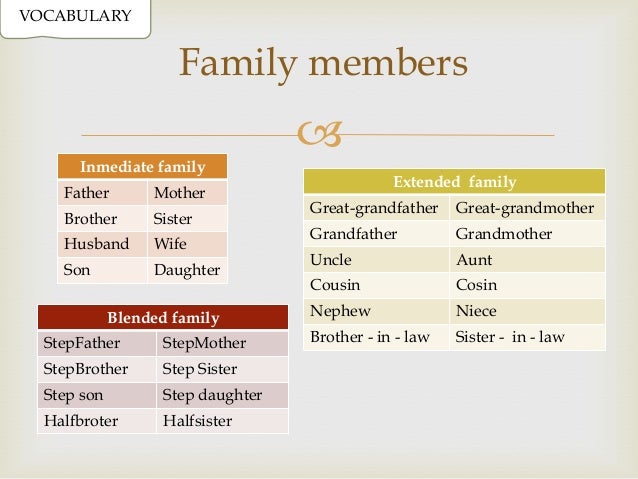
2. The family.

Unit 1. YOU AND YOUR ENVIRONMENT.
Lesson 2. The family.

INTERPERSONAL COMMUNICATION
MODELS OF FAMILIES


"A house is made of walls and beams; a home is built with love and dreams."-   Author Unknown  


Main models of families:
  • Nuclear families.
  • Single-parent families.
  • Reconstituted families.
  • Married couples without children.
  • Unmarried couples with or without children.
Find out your family history.


  • Content: Interpersonal relationships in the family. Responsibilities at home.
    • Content language: Family vocabulary: family members; types of families. Household chores.
  • Communication: English language: 
    • Who + 3 rd pers. sing. to make questions?
    • How long does it take you to... / It takes me + time expression.
    • Present simple.
  • Culture: Types of families. Sharing responsibilities.
  • Cognition: 
    • Knowledge: match, list, state, recall, identify
    • comprehension: explain, discuss


  • Reading activity.
  • Questionnaire.
  • Family tree.
  • Group discussion.
  • Flashcards activity.

viernes, 23 de octubre de 2015

1. Who are you?

Unit 1.    YOU AND YOUR ENVIRONMENT
Lesson 1.  Adolescent life and experiences. 
What we know about ourselves.

WHO ARE YOU AND WHAT ARE YOU REALLY LIKE?


YOUR IDENTITY: 

characteristics, attitudes, feelings, opinions and beliefs that distinguish you from others.


VIDEOFORUM

1- ¿Qué le ocurre al protagonista?
2- ¿Qué siente? ¿Cómo reacciona?
3- ¿Qué descubre de sí mismo?
4- ¿Qué aprende?


  • Content: Adolescence, identity and self-esteem. Life stages.
    • Content language: personality adjectives; life stages.
  • Communication: English language: 
    • Chunks of language: 
      • ...is a person who + 3rd pers. sing
      • ...is able to + inf
      • ... is willing + inf
      • I agree with...because...
      • I do not agree with... / A disagree with...because...
    • Present simple.
  • Culture: Knowing other people's personality. People diversity.
  • Cognition: 
    • Knowledge: define, describe, memorize, select, match
    • comprehension: explain, describe, distinguish


  • Flashcards activity.
  • Pair work.
  • Gap-filling exercise.
  • Group discussion.
  • Brain storming on the blackboard.

viernes, 12 de junio de 2015

Introduction.


WELCOME TO THE CITIZENSHIP LESSONS!


YOU AND YOUR ENVIRONMENT

HUMAN RIGHTS

NEIGHBORHOODS, TOWNS AND CITIES

DEMOCRACY

OUR WORLD AND THE FUTURE